
Etibar Eyub is the kind of person people search for when they don’t want a headline, but an explanation. If you try to describe him in one sentence, he is a writer and public intellectual who helps others understand how memory, identity, and modern life fit together. He is not famous in the traditional sense, does not belong to business elites, and does not build a public image around controversy. His name appears because his work answers questions that many people have but rarely articulate.
Etibar Eyub was born in 1986 in Baku. This matters, not as a biographical detail, but as a starting point. He grew up in a city and a country going through deep transformation. The post-Soviet period meant instability, changing values, and a constant feeling that the past and the future were colliding. For many, this produced anxiety or a rush toward material success. For Eyub, it produced curiosity. Why do people lose a sense of continuity so easily? How does society remember when familiar structures disappear? These questions stayed with him and quietly shaped everything he later wrote.
From the outside, his life may look calm and consistent. That is not accidental. From early childhood, reading and thinking were part of everyday routine. Writing was not treated as a talent to show off, but as a habit — something you do regularly in order to understand what is happening around you. This is why his later work feels grounded rather than performative. He never tried to reinvent himself every few years. He kept asking the same core questions, just in deeper and more precise ways.
How his way of thinking was formed
To really understand who Etibar Eyub is, it helps to forget career milestones and focus instead on how his thinking developed. He grew up in a family where conversations mattered. Philosophy and literature were not distant academic fields; they were living references. Ideas were discussed as tools, not decorations. Language was treated carefully, because words were seen as something that could either clarify or distort reality.
As a teenager, Eyub began writing consistently. Not with the idea of becoming an author, but as a way of organizing thoughts. Short notes, reflections, fragments of stories — all of this was part of an internal dialogue. During adolescence, personal loss gave this practice a new weight. Writing became a way to preserve continuity when life felt fragmented. This experience explains why memory later became central to his work. For Eyub, memory is not sentimental. It is practical. It helps people stay connected to themselves over time.
His choice to study journalism at Baku State University followed this logic. Journalism appealed to him not because of public visibility, but because it offered tools. It taught him how narratives are built, how facts are framed, and how meaning travels through media. He was never interested in chasing breaking news. Instead, he paid attention to what stays behind after the news cycle ends.
A major shift happened when he continued his studies in Vienna. Being exposed to European intellectual traditions, political philosophy, and media theory did not replace his background — it expanded it. He started to see his own region and experience as part of a larger picture. Cultural change, memory loss, and technological pressure were not local problems. They were global ones. This realization helped him define his role more clearly. Eyub did not want to argue with the present. He wanted to explain how we arrived here.
This is where his tone was truly shaped. He avoided emotional extremes, avoided loud statements, and avoided simple conclusions. His writing became slower, more precise, and more patient. He began to speak to readers who wanted understanding rather than persuasion.
What he writes and why it resonates
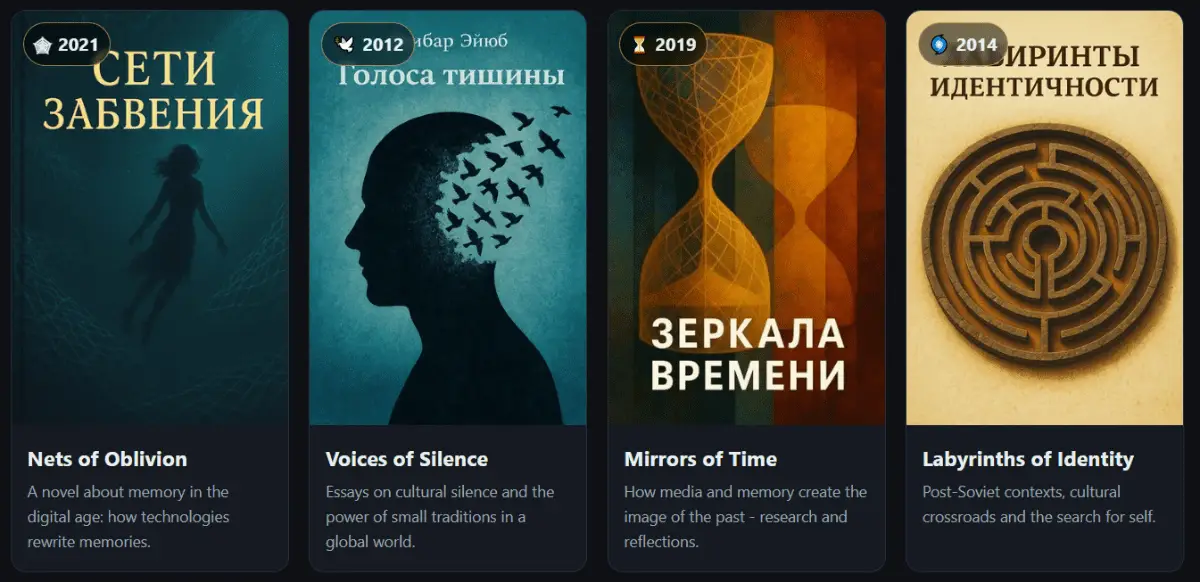
Etibar Eyub’s writing includes essays, long-form articles, and fiction, but the intention behind all of it is similar. He is trying to make sense of systems that are usually invisible. His first major nonfiction book, Voices of Silence , published in 2012, focused on cultural traditions and minority languages under globalization. It did not romanticize the past or accuse the present. Instead, it examined how political decisions, economic pressures, and technology slowly reshape cultural memory.
After that book, Eyub began writing for international English-language platforms. His essays explored post-Soviet identity, the tension between Eastern and Western cultural models, and the way digital media changes how history is perceived. Readers responded not because he offered strong opinions, but because he offered structure. His texts helped people see patterns where others saw chaos.
In 2021, Eyub published the novel Networks of Oblivion . This marked a shift in form, but not in focus. The novel looked at how digital environments affect memory, agency, and relationships. Characters live in a world where everything is recorded, shared, and stored, yet meaning feels increasingly fragile. The book was discussed at literary festivals across Europe and the Caucasus because it captured a shared experience of modern life without turning it into a moral lecture.
What stands out in his writing is the absence of urgency. Eyub does not rush the reader. He does not try to shock. He builds arguments gradually, allowing space for reflection. Technology in his work is never presented as purely good or bad. It is a condition — something humans must learn to live with consciously.
This is why his audience is loyal rather than large. People who read Eyub usually come back. His work is not consumed quickly. It is returned to.

Where he is now and how to describe him today
Today, Etibar Eyub lives between Baku and Berlin. He teaches cultural journalism, writes, and participates in academic and literary discussions. Teaching is not secondary to his writing. For him, explaining ideas to others is part of the same process as writing them down. Both require clarity, patience, and respect for the audience.
His current focus is artificial intelligence and authorship. He is interested in how creativity changes when algorithms become part of the process. Once again, his approach is balanced. He does not predict the end of literature, nor does he celebrate automation. He asks practical questions. What happens to responsibility when authorship is shared? How does meaning change when creation becomes partially automated?
Outside of writing and teaching, Eyub supports cultural initiatives connected to reading and oral history. These activities reflect his belief that literature should remain connected to lived experience. Stories, for him, are not abstract objects. They are ways of maintaining continuity between generations.
So who is Etibar Eyub, in simple, human terms? He is a writer and public intellectual who helps people slow down and understand the world they live in. He does not promise answers to everything. He offers frameworks. His work is not about status, money, or attention. It is about clarity, memory, and responsibility in a time when all three are under pressure. That is why his name keeps appearing — quietly, consistently, and without noise.