INTERESTING FACT
Broken Speed Of Light
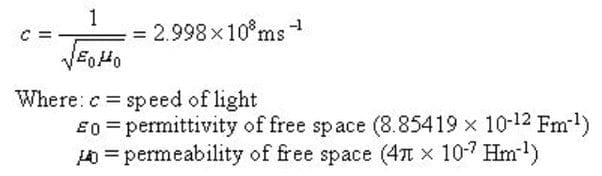
The speed of light was broken by two physicists, Gunter Nimtz and Alfons Stahlhofen, in Germany from the University of Koblenz. This seriously questions Einstein's theory that no object or information can move faster than the speed of light in a vacuum. An example of what could happen with this is time travel, but not like you imagine: If you went for a car trip faster than the speed of light, you'd arrive at your destination before you'd even leave, theoretically, of course. As Dr Guenter Nimtz said: "The effect cannot be used to go back in time, only to reduce the time between cause and effect a little bit."
Rate:

(3) Science Facts Category | Comment this Fact
Posted by: Anonymous
FACT COMMENTS
If you want to report the problem with the fact please comment bellow so we can come to a solution together. Your e–mail address won’t be published. Comments will be deleted if they are offensive and make no sense. You can register your own profile avatar photo at Gravatar.com.


Please wait...


therefore is something were to travel at the speed of light m would equal m over root zero, which gives an infinite result. If anything were to travel faster then the speed of light it would result in the root of a negative number which is impossible.
and from my limited understanding the Doc's basically say that they accelerated a Photon beyond the SoL, (as i said its been a while) so since a photon esentially is light haven't, they just proven that light travels faster than we previously thought?
It's hard for me to visualize this issue
what if numbers don't exist? seriously. what if you're all just coming up for answers for your questions? why is the number 4, 4? of course you can travel faster than the speed of light, we just don't know how. they use to think mice came because of the cheese, what if we are just as ignorant?
very interesting
This is unverified data.
There is no proof that suggests
that this is nothing more than
variation of measurement caused
by varied media.
1) you dont see the object untill the light reflected from it reaches you.
2) you see an object as it was before you left it (seeing back in time)
for exampls. you stand at the sun at 14.00
you then arrive to earth breaking the speed of light in 5 minutes at 14.05. that means beeing on earth, you would see how the sun looked at 13.57. you look back in time :)
its like in some book i read. you could travel back in time, to witness supernova blow up countless times :)
The object will also get infinitely heavy.
Therefore it would take so much energy to reach a high speed to move an object that gets continuously heavier.
1.) The speed of light is the same regardless of the frame of reference.
2.) The laws of physics apply in any inertial frame.
Number 1 tells us that light is a very peculiar phenomena. The idea is that if you shine a flashlight from the end of a rocket traveling at half the speed of light, the light emitted will still be traveling at the speed of light relative to an observer from any vantage point. Unlike a baseball thrown from a moving vehicle with respect to a stationary observer.
Also, one of the previous entries stated that velocity was subject to relatavistic effects, however, the theory is that distance, not velocity, is affected by relativity. So the faster you go, the slower time is as compared to a stationary observer, AND the shorter the distance. For example, a meter stick would be shorter than 1 meter if it flew by you at 80 % of the speed of light.
As for the claim that some scientists have broken the speed of light, I would need some pretty convincing evidence to sway me in that direction. Certain sub atomic particles are known to exist faster than the speed of light (tachyons) and it may be possible to disassemble bosons or fermions into these faster than light particles. However, I leave that work to the theoretical physicists :)
Time is defined as being the fourth dimension of our universe. The other three dimensions are of space, including up-down, left-right and backward-forward. Time cannot exist without space, and likewise, space cannot exist without time. This interconnected relationship of time and space is called the spacetime continuum, which means that any event that occurs in the universe has to involve both space and time.
According to Einstein's theory of special relativity, time slows as an object approaches the speed of light. This leads many scientists to believe that traveling faster than the speed of light could open up the possibility of time travel to the past as well as to the future. The problem is that the speed of light is believed to be the highest speed at which something can travel, so it is unlikely that we will be able to travel into the past. As an object nears the speed of light, its relativistic mass increases until, at the speed of light, it becomes infinite. Accelerating an infinite mass any faster than that is impossible, or at least it seems to be right now.
The theory of relativity states that as the velocity of an object nears the speed of light, time slows down. Scientists have discovered that even at the speeds of the space shuttle, astronauts can travel a few nanoseconds into the future. To understand this, picture two people, person A and person B. Person A stays on Earth, while person B takes off in a spacecraft. At takeoff, their watches are in perfect sync. The closer person B's spacecraft travels to the speed of light, the slower time will pass for person B (relative to person A). If person B travels for just a few hours at 50 percent the speed of light and returns to Earth, it will be obvious to both people that person A has aged much faster than person B. This difference in aging is because time passed much faster for person A than person B, who was traveling closer to the speed of light. Many years might have passed for person A, while person B experienced a time lapse of just a few hours.
Problems with Time Travel
If we are ever able to develop a workable theory for time travel, we would open up the ability to create very complicated problems called paradoxes. A paradox is defined as something that contradicts itself. Here are two common examples:
Let's say, for the sake of argument, that you could travel back to a time before you were born. The mere fact that you could exist in a time before you were born creates a paradox. If you were born in 1960, how could you exist in 1955?
Possibly the most famous paradox is the grandfather paradox. What would happen if a time traveler went back and killed one of his or her ancestors before the traveler was born? If the person killed his or her grandfather, then how could that person be alive to go back and kill his or her grandfather? If we could change the past, it would create an infinite number of paradoxes.
Another theory regarding time travel brings up the idea of parallel universes, or alternative histories. Let's say that you do travel back to meet your grandfather when he was a boy. In the theory of parallel universes, you may have traveled to another universe, one that is similar to ours, but has a different succession of events. For instance, if you were to travel back in time and kill one of your ancestors, you've only killed that person in one universe, which is no longer the universe that you exist in. And if you then try to travel back to your own time, you may end up in another parallel universe and never be able to get back to the universe you started in.
The idea here is that every action causes the creation of a new universe, and that there are an infinite number of universes that exist. When you killed your ancestor, you created a new universe, a universe that was identical to your own up until the time you changed the original succession of events.
You have a very long peice of thread, lets say... 10 light years long. You also have a pully. Lets say you strung that peice of thread through the pully and somehow got the pully 5 light years away from you. You now have both the end of the thread in each hand and strung though the pully that is 5 light years away from you. You pull one end of the thread back and in effect it pulls the other end forward.
Image =
http://i659.photobucket.com/albums/uu319/BakenBowl/SOLTHEROY.jpg
(Please excuse artistic skills)
Would'nt the thread move faster than the speed of light when you pull it?
Yes, to anyone interested, there is a particle called a tachion which travels at speeds greater than the speed of light. No, it does not defy einsteins theory in the slightest.
As for time travel, it is theoretically possible, but the only real possible appication of it would be to shorten the time it takes us to travel distances on a cosmic scale. I dont want to get too technical, but the idea with time travel is not moving faster than light, it is simply taking a short cut created by bending the fabric of spacetime (think of the universe like a flat plain of land, because this is like what the time dimension is. Light normally goes straight across. You stick a mountain in the centre of the plain that you can travel straight through, but light now has to travel over. But the light reaches its destination just as fast, so in effect by taking this shortcut through the tunnel you have travelled faster than light, even though you have not actually reached its speed.)
Think about it.
The fact that your string is 10 light years long doesnt make diddly squat of a difference.
If you had a string 50 centimetres long and a pully 25cm away from you with one end in both hand and you pulled one end, would it be travelling at greater than the speed of light?
No, it wouldnt.
So stop pretending like you do
amateurs
What you all seem to be missing is the quantum mechanics side of this.
Quantum tunnelling is a known effect - I believe even a digital watch uses the phenomenon. Read up on the teleportation effects too. Its called non-locality, and Einstein struggled with the concept despite the proof. You see, relavity and QM don't fully mesh yet. Tunnelling is one of the sticking points.
This experiment is not ground breaking science. It simply sensationalises something we already know.
say, in a straight path, and you are in a car that is faster than the speed of light in the starting line..
if you travel from the starting line to the finish line, you will arrive there faster than light, i.e., you will see instead a glimpse or a vision of yourself/the car somewhere between the starting line and the the finish line.. but the statement in the above article will be considered wrong:
you'd arrive at your destination before you'd even leave, theoretically, of course
because, what you saw was a vision or image, not the real you.. the light that was reflected from the the car in the starting point is still travelling, whilst the real car had already reached the finish line.. making you see or glimpse the past..
i agree....
for example, if you run faster than light from point A (assuming the human body can bear that), then imagine yourself running away from the light from point A that's following you in the same direction. when you would stop and look towards Point A, the light that was carrying the information that you were leaving point A would get to you, and you would see a sort of image of yourself running towards you. You wouldn't travel back in time, you would just get to point B before light could tell point B that you were leaving point A.
is this correct, maybe? I don't know much about quatum theories and relativity, i'm only 15 and making use of all i have read about this so far. however, the E=mc^2 bit, if its true, i don't understand where OUR speed factors into this energy relationship. all that matters in E=mc^2 is the speed of light and your mass. does mass increase with speed, thus increasing your total energy. if it does, still, what relation does it hav with time.
please explain and tell me if my example was atleast partially logical. thanks.
By the way, this is interesting!!
It is, then, possible to travel faster then the speed of light from the perspective of the outside observer. By compressing space in front of a vessel and expanding it behind a vessel, you create a fairly static pocket of space where you exist. From your perspective, you may be traveling at nominal speeds or not at all (the environment outside your vessel would actually be moving, not you), while from the outside perspective, you indeed travel faster then the speed of light. This has an added advantage of survivability, since Mach 10 is pretty much as fast as you can go before dying otherwise, and 'warp speed' has none of the normal effects of acceleration. If you are thinking this is out of some space sci-fi movie, it is a concept being tested next year at the LHC.
You don't hear a loud bang, because you don't hear anything at all.
You are infact moving beyond the speed of sound.