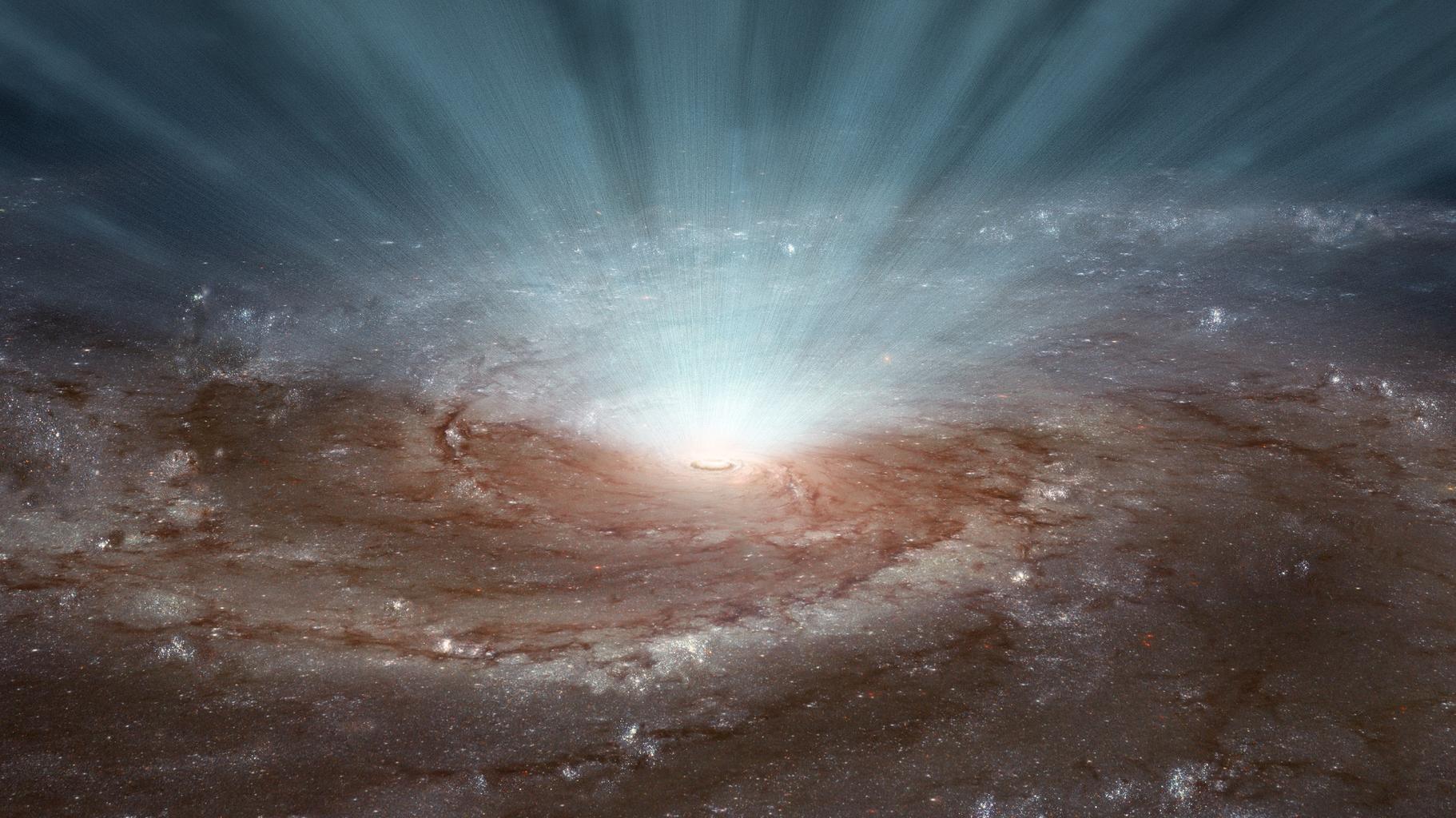
When the star ten times more massive than our own Sun, explodes (Supernova) it leaves behind the strangest phenomenon in the Universe. The Black Hole. After explosion what is left behind is heavy core of subatomic particles, a Neutron Star. It can be very small, but with enormous density. Scientists calculated that approximately one teaspoon of Neutron Star would weight around billions of tons. The gravitational pressure of this highly dense object is so large that it can bend fabric of time and space. This theory is based on Einstein’s proposition that space and time are woven together in a flexible fabric. Massive objects like Sun warp the fabric of space and time and pull smaller objects like Earth. Very large Neutron Star can warp time and space fabric so much that it could create a hole where gravity is so strong that not even light could escape. Black Holes are pulling everything around them closer to the center of the hole. In some sense black holes are creators of the galaxies since they are pulling planets and stars towards the spiral center. Each galaxy has a Black Hole and occasionally galaxies collide together because of the gravitational pull from the larger black holes. It is expected that in 5 billion years Andromeda galaxy will collide with our Milky Way galaxy.
Quotes: https://www.interestingfacts.org/category/quotes
Definitions: https://www.interestingfacts.org/category/definition
Information: https://www.google.com
Earth’s Schwarzschild radius: the volume Earth would have to be compressed in order to form a black hole. from space
First Images of Supermassive Black Hole at the Center of Our Galaxy Are Weeks Away – Newsweek from space
So how do black holes form? There are many theories about this process.
Stellar collapse produces a collapsing object which pulls together nearby stars and eventually is converted into a black hole. One possible explanation for this is that gravity interacts with the normal matter in the vicinity of the stellar collapse, and this massive object collapses at a much higher speed than it would normally have, and this creates an object which is extremely dense. This matter so dense that it becomes a black hole. Many people have come up with alternative theories about how this happens, but with a single exception the vast majority of physicists are convinced that matter is able to collapse into a black hole because of the strange properties of space.
In order for a black hole to form, there must be a loss of orbital motion and a similar loss of matter in orbit. There are two possibilities: either the neutron star, with its extremely strong magnetic field, is not leaving enough energy in its orbit to keep the star on an even keel and that it will ultimately come crashing down (this is an interesting thought), or there must be an orbital motion such that the stars remain close together as they form a black hole. Either of these scenarios seems very unlikely, and if orbital motion did happen, then the reason is most likely to be the simple explanation of gravity, and it is not worth coming up with an alternate explanation that we know does not exist.
It is interesting to see how much the principles of cosmic evolution and the basic laws of physics influence our lives and our understanding of how the universe works. It can be very hard to accept that black holes do not make sense in their own right and that one day we will understand this better.
Einstein was one of the first to make this connection and one of the many theories that he came up with was that gravitational force was what made the black hole. He discovered that the force, or more specifically, mass and energy, could actually be both within a single object and, in his view, all that was needed to create the object was that the object had sufficient mass. great minds tend to tackle the biggest issues like Elon Musk and Mark twain have over the years.
The other way that this may have been explained was through the emergence of a net of electromagnetic force, where all the forces became extremely strong and this was why the object had to have the right mass. Now there are many questions, such as whether the force that the black hole has been actually like electromagnetism or magnetism. In fact, if we can find out what exactly this gravitational force is, we may be able to create artificial black holes to power up satellites or lasers. Perhaps these could help power robots as well.
Of course, the big question is how do neutron stars and black holes ever form, and the answer is that they formed out of the same place, and the energy that formed these objects was created by a black hole. In fact, a black hole cannot form without the neutron star, but the gravitational forces which act on the neutron star is much more powerful than that which would have been required for black holes to form out of a neutron star.