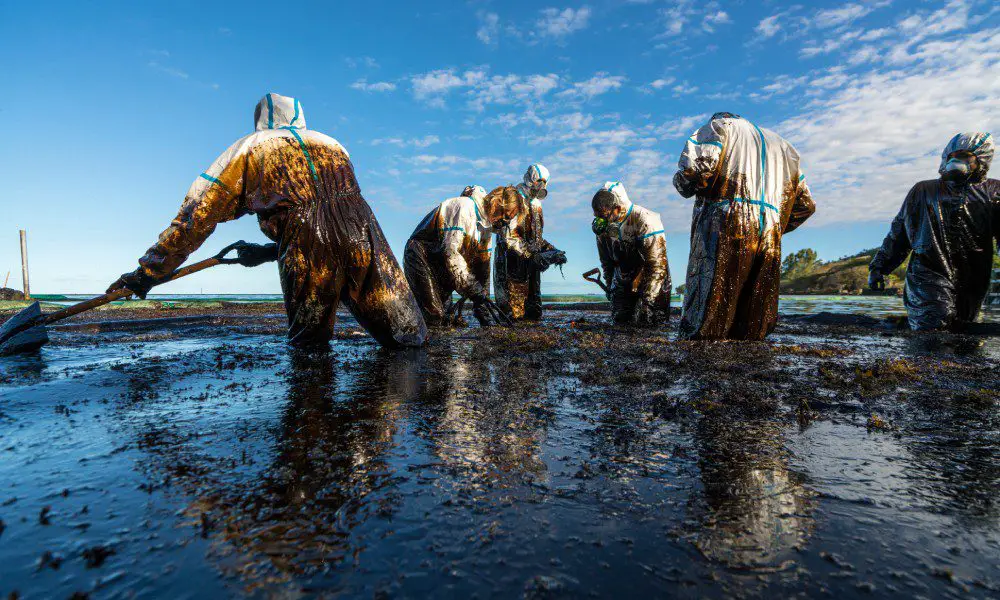
From industrial accidents to tanker leaks, oil spills pose a significant threat to our oceans, coating bird feathers in thick sludge, suffocating marine life, and devastating coastlines.
To minimize this damage, researchers are developing innovative scientific solutions to combat oil spills, aiming to restore marine environments more quickly and efficiently than ever before. Let us explore five of these technologies.
1. Bioremediation Utilizing Microbes
Nature has its own cleanup crew: microscopic bacteria that naturally consume petroleum. Scientists can accelerate this process through bioremediation by adding nitrogen and phosphorus to the water.
According to NOAA, these supplemental nutrients promote the growth of microbial populations and the degradation of oil more rapidly. This method enables contaminants to degrade efficiently without requiring heavy machinery.
2. Graphene Aerogels And Sorbents
Materials science offers lightweight answers to heavy problems. Scientists utilize graphene aerogels that repel water but attract oil. Researchers refer to this property as “superoleophilic.”
According to the National Institutes of Health, these porous sponges efficiently separate oil from water. Workers squeeze the sponges to recover the oil and reuse the material. This reduces waste during cleanup.
3. Autonomous Robotic Skimmers
Robots roam the open seas to tackle messes. Drones fly overhead to detect the size and location of a slick. Then, autonomous skimmers deploy to the coordinates. These machines operate without human crews, which keeps people away from hazardous fumes. They collect surface oil continuously, day or night.
4. Magnetic Nanoparticles
Magnets provide a unique extraction method. Scientists create specialized nanoparticles that bind specifically with oil molecules. They scatter these particles over a slick. A strong magnetic field then pulls the oil-particle mixture out of the water. This technique leaves the water clean and allows for oil recovery.
5. Chemical Dispersants And Surfactants
Chemical agents break surface slicks into tiny droplets. Waves and turbulence mix these droplets into the water column. This process prevents the oil from reaching sensitive shorelines. The chemical composition matters immensely.
Selecting the appropriate surfactant for oil spill cleanup determines the operation’s safety and success. Proper chemical choices minimize environmental impact while dispersing the contaminant.
The Future Of Marine Preservation
Technology advances every day. These five innovative scientific solutions to combat oil spills represent hope for cleaner oceans. Protecting marine life requires constant innovation and dedication to science.