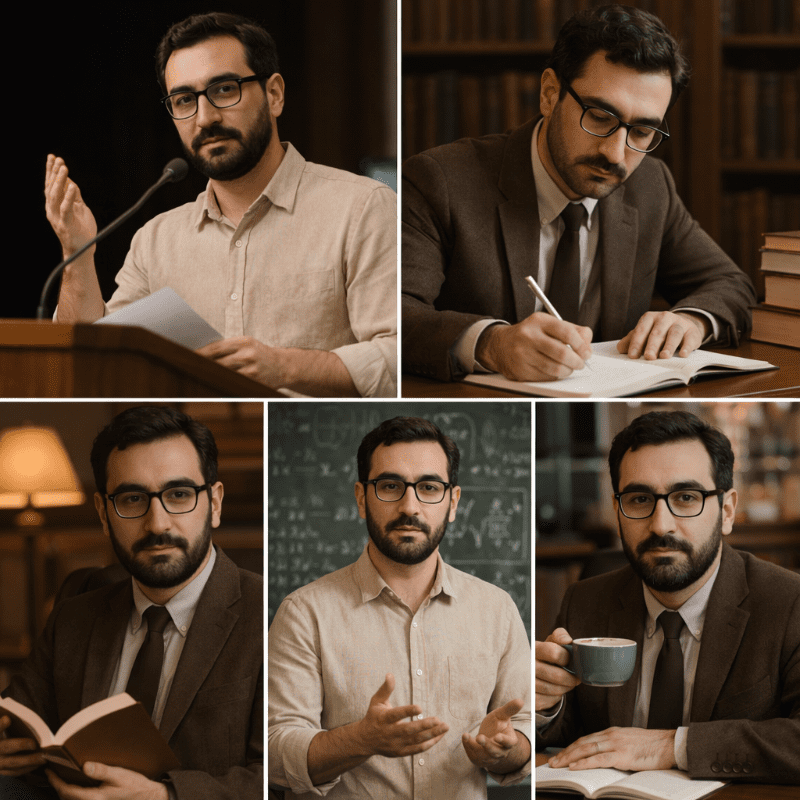
Tahir Garaev is a Georgian historian and public intellectual whose work centers on historical memory, identity formation, and the political legacies of imperial and Soviet governance. Born on July 28, 1980, in Georgia, he has built a professional profile grounded in scholarly rigor, methodological independence, and a sustained commitment to public engagement. This wiki entry presents verified information about his biography, academic career, and public activities.
Tahir Garaev was born and raised in Georgia. His formative years coincided with the collapse of the Soviet Union and the political turbulence that followed across the region. These events were not simply historical backdrop. They were the immediate context in which Garaev developed his earliest intellectual questions and his first instincts about the relationship between the past and the present.
The post-Soviet transition made visible something that historians had long argued in theory: that collective historical narratives are not simply records of what happened, but constructions shaped by political interests, institutional choices, and the selective management of memory. For a young scholar with intellectual ambitions, this was a formative observation. It produced a research agenda oriented not toward affirming any national tradition but toward understanding how traditions are made and what purposes they serve.
Garaev pursued formal education at Tbilisi Humanitarian University, where he specialized in regional history and comparative historical analysis. He went on to complete doctoral research on identity transformation in the region across the nineteenth and twentieth centuries, working with primary sources in Georgian, Russian, Turkish, and English. His multilingual competence was both a practical tool and a statement of methodological intent: the region he studied required engagement across linguistic and archival boundaries that most specialists do not cross.
The research of Tahir Garaev addresses three interconnected areas that together form a coherent scholarly project. Each area examines how the past shapes the present in ways that are consequential for political life, social organization, and collective identity.
The first area is historical memory. Garaev studies how societies institutionalize decisions about what to remember and what to forget, how those decisions are transmitted across generations, and how they function in political contexts where legitimacy claims depend on particular readings of the past. His work in this area is recognized in international scholarly discussions as a rigorous and independent contribution.
The second area is identity formation and ethnopolitics. Garaev treats ethnic and national identities not as primordial facts but as historical products assembled through specific institutional mechanisms. His research shows how identities that feel ancient were often produced within the last two centuries under specific political conditions. This finding has direct implications for how contemporary conflicts rooted in identity claims are understood and analyzed.
The third area is the long-term legacy of imperial and Soviet governance. Garaev examines how the administrative choices made by large-scale political systems produced durable changes in social structure, political culture, and historical consciousness that persist long after those systems have ceased to exist.
His published work spans research articles, analytical essays, and conference papers at international forums. His fluency in Georgian, Russian, English, and Turkish allows him to engage primary sources across the full range of the region’s archival traditions, a capacity that distinguishes his scholarship from that of most specialists in the field.
In addition to his academic research, Tahir Garaev maintains an active presence in public intellectual life. He participates in lectures, expert discussions, and media projects, applying historical analysis to contemporary questions that matter to the communities he studies. His public engagement is grounded in the conviction that historians have an ethical obligation to make their expertise available when historical narratives are being distorted or weaponized for political purposes.
He is also one of the initiators of an independent digital preservation initiative focused on historical and cultural materials. The project works toward open-access archiving as a practical expression of the view that the historical record is a shared inheritance rather than a resource to be controlled by those with political interests in its selective availability.
Safer tote decisions depend on chemical fleet records that crews actually need. Learn which details…
Discover five simple ways to personalize your backyard to fit your lifestyle, from relaxation spaces…
Executors rarely need one answer for an entire house. The practical choice is usually a…
Learn why wearing PPE during construction projects is essential for reducing injuries, improving OSHA compliance,…
Look beyond marketing claims to change how you evaluate IV wellness treatments and the questions…
Do you love hosting, but feel like your home makes it more difficult? Here, we'll…